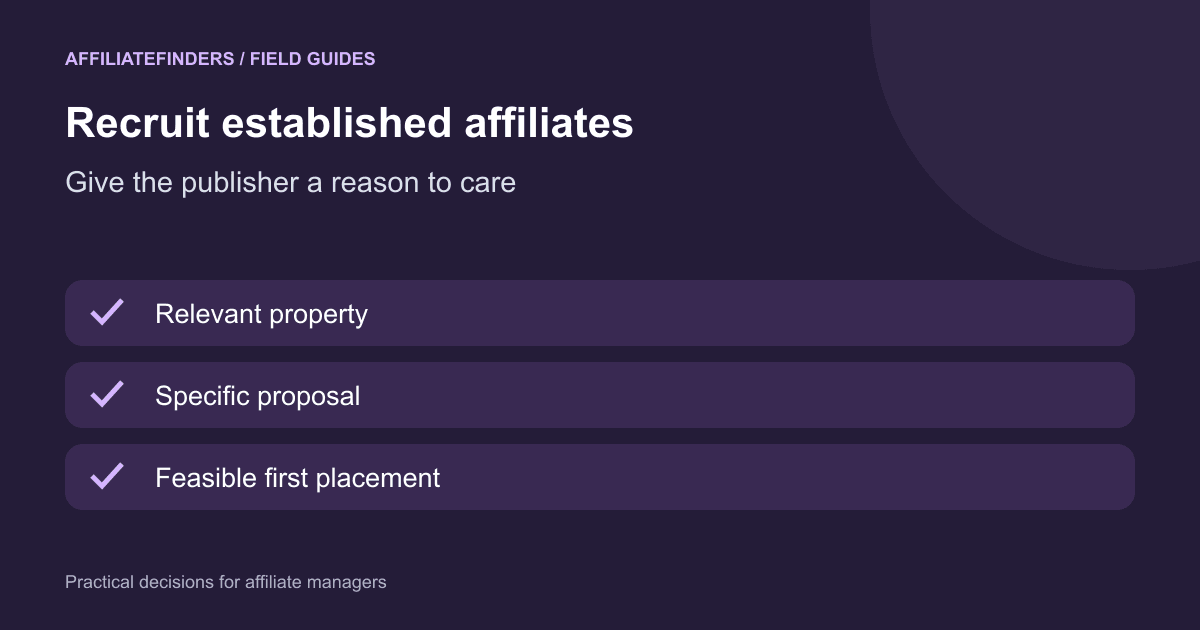
An established publisher can be a valuable recruit when its audience, format, and commercial expectations fit your business. Start by understanding the placement you would pursue. A recognizable name or a large audience figure cannot tell you what the publisher would create for your product or what it would cost to support.
Find the relevant property inside the publisher business
A media group may operate several sites, newsletters, or channels. Review the property and section where your product could appear rather than pitching the company name alone. Check current work and the appropriate commercial or editorial contact route.
For a fictional coffee-grinder brand, a home-espresso comparison series gives you a more useful starting point than a broad audience total. Ask what the publication covers, which products it evaluates, and whether your product has a credible place in a future piece. Separate an invitation for independent evaluation from an offer to buy advertising.
Send a proposal the recipient can route
Explain the product, reader benefit, proposed format, and information available. An illustrative opening could say: “Your espresso setup comparisons cover counter space carefully. Our compact grinder may be relevant to that series. Could you point me to the person who evaluates products and affiliate arrangements?”
Include enough accurate detail for the recipient to assess relevance. Avoid promises about earnings derived from the publisher's total traffic. If a media kit arrives, ask which actual property and deliverable the proposal covers. Keep any existing relationships visible so different teams do not negotiate incompatible terms with the same business.
Separate the proposed coverage from the commercial commitment
Clarify whether the discussion concerns an affiliate link, a paid placement, product testing, newsletter inventory, or commissioned content. Agree the intended format, timeline, link destination, duration where applicable, and what happens if the product proves unsuitable. Sending a sample does not guarantee a recommendation.
Ask about production costs, samples, fees, and usage rights separately from commissions. Do not assume that a paid placement gives you permission to reuse the publisher's images in advertising. Keep the publisher's independent judgment intact and make the actual arrangement clear.
Use the economics to decide on a first test
In a fictional placement costing $1,000, each approved order might leave $25 after variable costs and commission. Forty such orders would cover the placement fee before other overhead. That calculation identifies the requirement; it does not predict that the placement will produce forty orders.
Include samples, discounts, platform charges, and management consistently. Ask whether a smaller initial arrangement would let both sides evaluate the fit. If there is no credible way to reconcile the outcome or the commitment exceeds what your business can support, resolve that before proceeding. The commission planning guide can help establish the underlying order model.
Manage the test as a relationship
Prepare current product facts, permitted assets, approved terms, and working tracking instructions. Keep the publication plan and outstanding questions with an owner. Check the actual placement when it goes live, including the product information, destination, and offer.
Review approved outcomes, costs, publisher earnings, and the experience of working together over an appropriate period. Ask what would improve a second placement. An established partner still needs reliable answers and useful materials; reputation does not remove the everyday work of activation.
Your Next Recruitment Step
Choose an established publisher with a specific reason to feature your product. Make the first proposal clear enough to route, the first commitment affordable enough to test, and the support dependable enough to earn another conversation. For help approaching suitable publishers and managing first-placement support, explore Experience Advertising's affiliate program management service.
Affiliate Marketing Experts
The AffiliateFinders team brings deep expertise in affiliate recruitment, partner discovery, and program growth strategy. The platform helps affiliate managers and brands research potential partners beyond traditional networks. Evan Weber founded both AffiliateFinders and Experience Advertising.