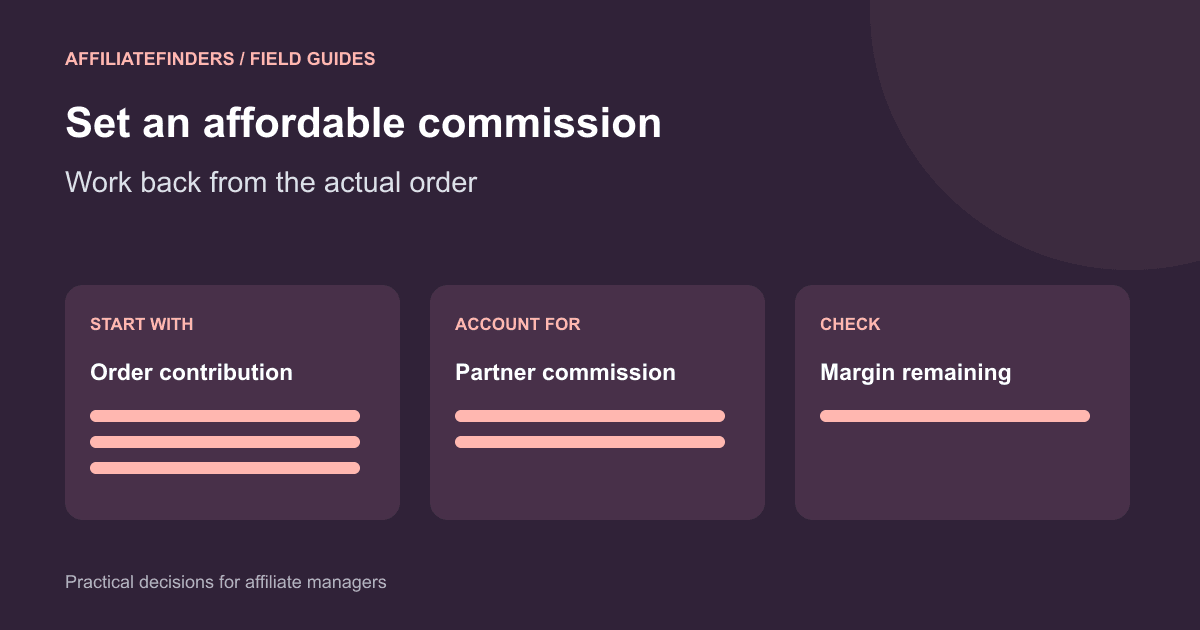
Your commission needs to give a publisher a worthwhile reason to promote while leaving your business enough margin to serve the customer. Start with an actual order and its costs. Then choose a structure partners can understand and your tracking can calculate reliably.
Calculate the room in one real order
Consider a fictional $100 order after the customer discount, excluding tax. Product cost is $35, fulfillment and shipping cost $12, payment processing is $3, and the expected returns allowance is $5. That leaves $45 before affiliate costs. A 10% commission on the $100 commissionable value costs $10, leaving $35 before platform fees, management costs, fixed placements, and overhead.
Change the inputs to your actual costs. If a discount reduces that order to $80 while those other example costs remain $55, only $25 remains before affiliate costs. A 10% commission then costs $8, leaving $17 before the remaining costs. Confirm what your platform treats as commissionable value. The same headline rate can produce very different economics on discounted orders.
Use the same commissionable-value definition in your model and the partner-facing terms, including how tax and shipping are treated. Keep this model with the recruitment brief so the manager knows which rates and offers are actually approved.
Choose what event earns a commission
A percentage can suit orders with different values. A fixed amount can suit a clearly defined qualified outcome. A recurring commission can fit subscriptions when you can reliably reconcile renewals, refunds, and cancellations.
Write down the qualifying event before selecting a rate: paid order, approved lead, activated account, or another verified milestone. A form submission and a qualified customer are different outcomes. If you pay for leads, define duplicates, eligibility, validation, and disputes so a publisher can assess the opportunity.
Keep tiers specific and affordable
A tier should reward an outcome you actually want. That might be approved new-customer orders or retained subscription revenue. Specify the measurement period, whether the higher rate applies to all eligible transactions or only those above a threshold, and when the rate resets.
Model a partner crossing the threshold before announcing it. A retroactive increase can change the cost of the entire month's sales. Do not copy a tier ladder merely because it looks motivating. Confirm the resulting economics and test the platform calculation.
Treat attribution terms as part of the offer
Publishers need more than the headline percentage. Explain the referral window, attribution rules, excluded products, promotional restrictions, approval period, and payment process. A generous rate with frequent unexplained reversals can be a poor opportunity.
Avoid calling a referral window a guarantee. Eligibility depends on the agreed rules, tracking conditions, and the purchase. Make the terms easy to find and give partners a route to query missing or disputed transactions.
Review total cost and partner earnings together
Track approved commission, platform charges, fixed placement fees, samples, bonuses, and management costs. Revenue divided by commission alone is not a complete profitability measure. On the partner side, inspect approved earnings per click and the effort required to create the placement.
If earnings disappoint, investigate conversion, audience fit, and order value before raising the rate. If margins disappoint, examine discount stacking, returns, and attribution before cutting every partner. Announce necessary changes with the notice required by your agreements and explain how existing transactions will be handled.
Your Next Recruitment Step
Build a one-page commission model using three real order types: full-price, discounted, and returned. Then write the partner-facing terms in plain language. A rate that survives both exercises is a stronger offer than an unsupported industry benchmark. For support managing commission strategy alongside recruitment and partner activation, explore Experience Advertising's affiliate program management service.
Affiliate Marketing Experts
The AffiliateFinders team brings deep expertise in affiliate recruitment, partner discovery, and program growth strategy. The platform helps affiliate managers and brands research potential partners beyond traditional networks. Evan Weber founded both AffiliateFinders and Experience Advertising.