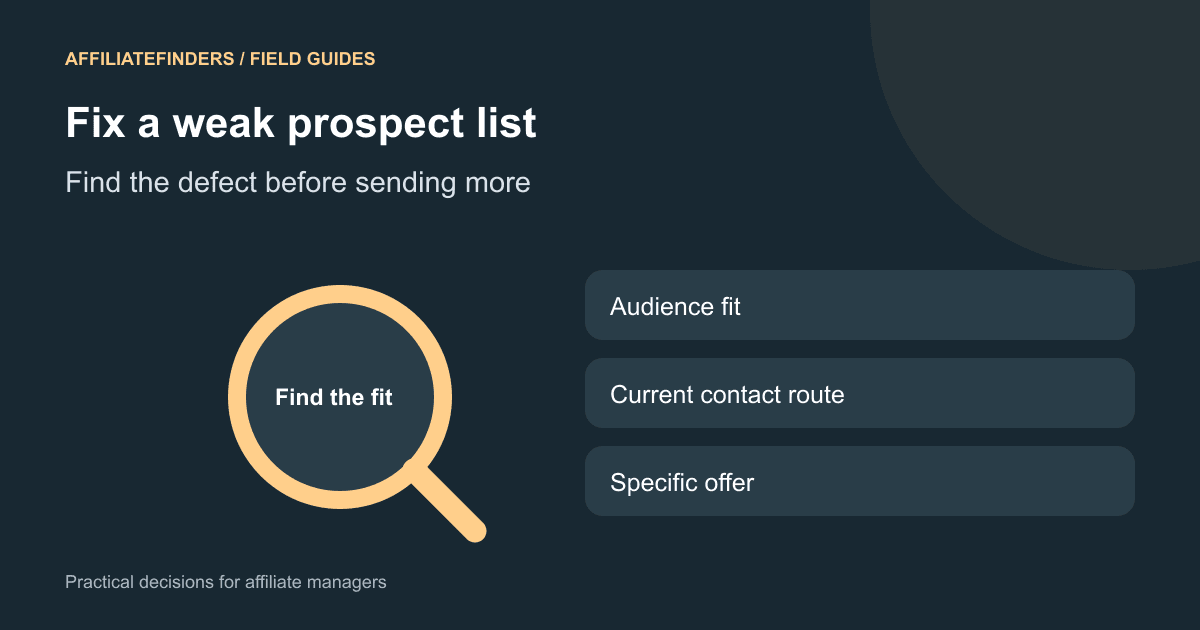
If you keep collecting prospects but have few worthwhile conversations, inspect the research before increasing the sending volume. A large list can hide broad targeting, duplicate properties, stale contact routes, and products with no clear place in the publisher's work. Audit a small sample and fix the repeated defect.
Read ten research records as if you had to send the invitation
For each record, open the actual property and the content that supposedly establishes fit. Can you explain the reader's problem, your product's relevance, and a realistic way the publisher could cover it? If the record contains only a name, category, and estimated traffic, the research is unfinished.
Suppose a fictional compact-furniture brand has ten home-related prospects. Four cover luxury houses, two serve countries the brand cannot ship to, and one is a duplicate property. Those seven names may be perfectly legitimate publishers while still being poor invitations for this product. Correct the brief instead of treating a low reply count as evidence that affiliates are uninterested.
Find the specific defect, then choose a repair
Use the audit to distinguish a discovery problem from an outreach or onboarding problem. Read real cases behind the count. The same symptom can have several causes, and the repair should follow the evidence rather than a blanket change in software or email frequency.
A working diagnosis sheet
| What you find | What to change | Evidence the repair is ready |
|---|---|---|
| Broad category matches, little product fit | Narrow the buyer question and served markets | A specific relevant article or series for each shortlisted property |
| Several records for the same relationship | Match company, property, and previous conversations | One owner and a preserved contact history |
| No reliable way to reach the decision-maker | Check the publisher's current business contact preferences | A documented appropriate route, with uncertain records held back |
| Relevant publisher, generic invitation | Propose one audience benefit and manageable decision | A message grounded in work you actually reviewed |
| Interested replies but no promotion | Resolve samples, terms, links, or timing | An owned next action and realistic placement plan |
Check the offer before blaming the list
A relevant publisher still needs something worth evaluating. For the furniture brand, useful details could include folded dimensions, price, served markets, sample availability, and accurate affiliate terms. A vague invitation to join leaves all of those questions with the recipient.
Write one proposed message for your strongest prospect. Explain why the product fits the specific content and ask whether a short brief would help. If your team cannot answer likely product or commercial questions, finish that work first. The placement-led recruiting guide shows how to build the invitation.
Test a corrected batch and keep the exclusions
Use a manageable batch that your team can research and support properly. Record the qualification reason, contact route, invitation date, response, and next action. Respect declines and stop requests, preserving that history when lists are refreshed.
Compare the corrected process with its own earlier work using the same definitions and enough time for responses. Look at whether conversations become more relevant and whether interested partners can progress. Small samples can reveal operational defects without proving a universal response-rate improvement. Keep exclusions and their reasons so the next researcher does not rebuild the same weak list.
Your Next Recruitment Step
Take ten current records, identify the most common reason they are hard to approach, and repair that input. Then use the recruitment pipeline to follow qualified opportunities through to a verified promotion. If you want support researching suitable affiliates and managing the conversations that follow, explore Experience Advertising's affiliate program management service.
Affiliate Marketing Experts
The AffiliateFinders team brings deep expertise in affiliate recruitment, partner discovery, and program growth strategy. The platform helps affiliate managers and brands research potential partners beyond traditional networks. Evan Weber founded both AffiliateFinders and Experience Advertising.